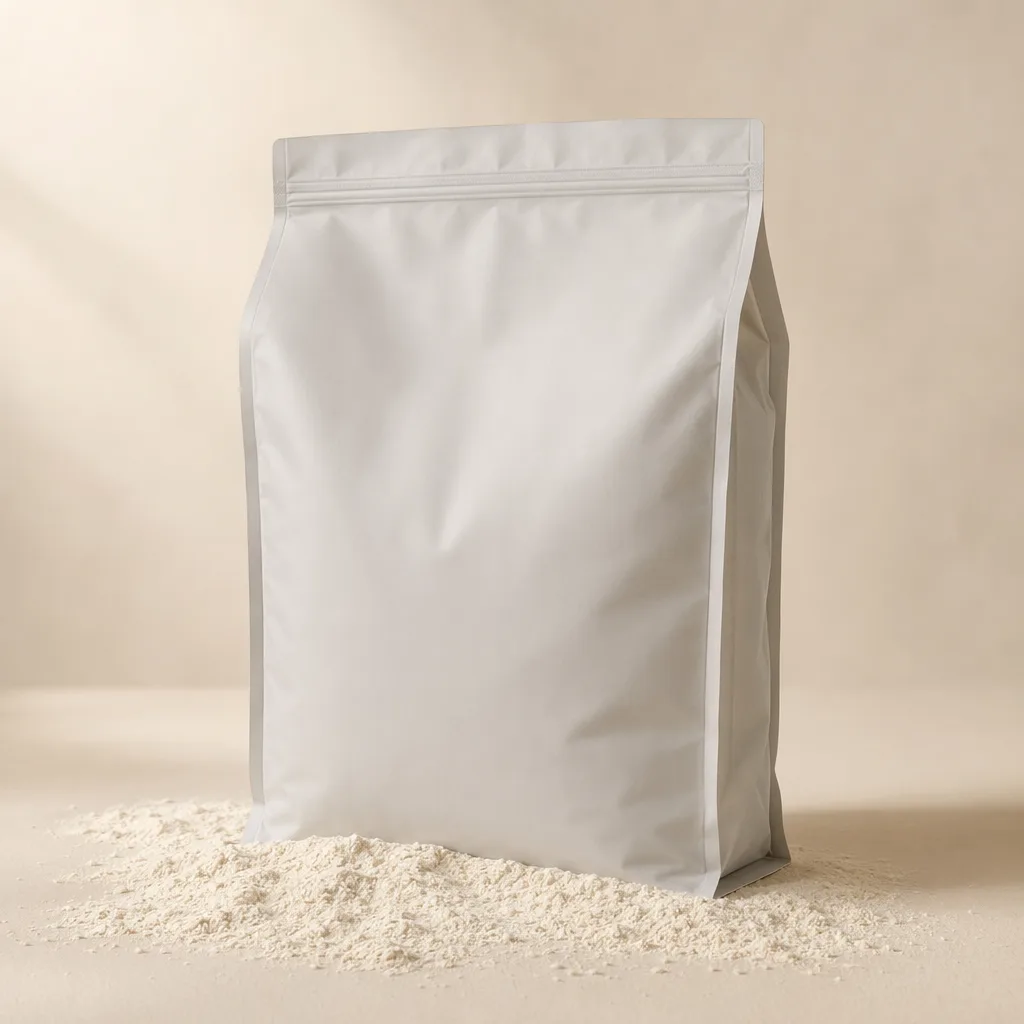
Brewing Beta-Glucanase Enzyme
Brewing beta-glucanase enzyme is a dry processing aid that hydrolyzes beta-glucans in barley, rye, oat, and other cereal mashes to lower viscosity and support wort or wash separation. ART-BW-052 is formulated for distilled spirits production where high-glucan raw materials can slow lautering, mash transfer, and filtration. Supplied in 10 kg foil pouches, it is available for international B2B supply with wholesale pricing on request through the bulk quote channel.
- ✓ Free worldwide shipping
- ✓ ISO-aligned manufacturing
- ✓ Certificate of Analysis on request
- ✓ Bulk & custom volumes quoted on request
Overview
ART-BW-052 is a concentrated brewing beta-glucanase enzyme preparation for distilleries and brewing plants processing barley, rye, malted cereals, adjunct grains, or high-fiber mash bills. The enzyme targets beta-1,3 and beta-1,4 glucan linkages that contribute to mash viscosity, slow wort runoff, and filter loading. In practical use, it helps standardize process flow when raw material beta-glucan levels vary by crop, malt modification, or adjunct ratio.
Typical specification targets include dry powder appearance, moisture not more than 8%, activity declared on the certificate of analysis, and 40-80 mesh flow characteristics suitable for pre-dispersion into mash water or direct addition to a mixing vessel. As an enzyme preparation, live cell count specifications such as CFU/g are not applicable. The usual working range is pH 4.5-6.0 with strongest process compatibility in the 45-65 °C mash window; activity decreases after high-temperature wort boiling or dedicated heat inactivation. For related production inputs, see our brewing and winemaking yeast category.
Applications
- Distilled spirits mash processing: supports smoother transfer, pumping, and separation in malt whisky, grain whisky, rye whisky, and neutral spirit operations using barley or rye-rich grists.
- Lautering and filtration: reduces viscosity caused by soluble glucans, helping improve bed permeability and reducing pressure rise across filters in process trials.
- Adjunct cereal processing: useful where unmalted barley, rye, oats, or mixed grains increase glucan load and create inconsistent flow behavior.
- Process optimization: can be evaluated alongside mash temperature profile, grist particle size, rest time, and solids ratio to improve throughput without changing the spirit style target.
- Industrial scale dosing: starting evaluation ranges commonly fall around 20-100 g per metric ton of grist, then are adjusted by lab mash, pilot run, raw material analysis, and plant residence time.
Storage and Handling
Store unopened 10 kg foil pouches in a cool, dry, odor-free area away from direct sunlight, steam lines, and strong oxidizing agents. Recommended storage is 5-25 °C with relative humidity controlled to protect powder flow and activity. Keep packaging sealed after opening and use clean, dry utensils to avoid moisture uptake. Under recommended conditions, typical shelf life is 12-18 months, subject to the activity retention statement on the lot-specific documentation.
For best dispersion, pre-mix the powder into a small volume of process water or add gradually into a well-agitated mash zone. Avoid inhaling dust and use local plant procedures for enzyme handling, including gloves, eye protection, and respiratory protection where powders are charged manually. Do not add directly to boiling wort or wash if enzyme activity is required in the mash stage.
Quality and Documentation
ArtemisYeast supplies ART-BW-052 for inquiry-only wholesale procurement, with lot traceability and export documentation aligned to industrial ingredient purchasing requirements. A certificate of analysis can list enzyme activity method, appearance, moisture, microbiological limits where applicable, batch number, manufacturing date, and expiry or retest date. Specification sheets, allergen statements, non-GMO status statements where available, and food-grade declarations can be requested during technical review.
Manufacturing and packing controls are managed under documented food-safety systems, and HACCP, ISO 22000, FSSC 22000, Halal, or Kosher documentation may be available depending on production site and lot. Procurement teams can review documentation through ArtemisYeast quality support before confirming orders. For commercial terms, packaging configuration, palletization, and destination-specific paperwork, request a bulk quote on request using SKU ART-BW-052.
Storage & Handling
Refer to the CoA for product-specific storage conditions. Ship cold-chain where required.
Quality & Documentation
Manufactured under ISO-aligned quality management systems. Full documentation — Certificate of Analysis (CoA), Material Safety Data Sheet (MSDS), formulation summary, and stability data — is available on request. Email info@artemisyeast.com with the SKU.
About this product
01 What is the typical shelf life?
02 Do you offer documentation (CoA, food-grade declaration)?
03 What is the minimum order quantity?
04 Is bulk pricing available?
05 How is this product shipped internationally?
More from Brewing & Winemaking Yeast
Super Turbo Yeast for High-Gravity Fermentation
Active dry super turbo yeast for craft brewers, winemakers, distillers, and industrial fermentation.
Dry Fermentation Nutrients and Protectors for Yeast
Active dry nutrients and protectors for craft brewers, winemakers, distillers, and industrial fermentation.
Dry Winemaking Enzyme for Fermentation Processing
Active dry winemaking enzyme for craft brewers, winemakers, distillers, and industrial fermentation.
Super Turbo Yeast for Craft Brewing, 10 kg Pouch
Super Turbo Yeast for craft brewing applications. Active dry super turbo yeast for craft brewers, winemakers,…